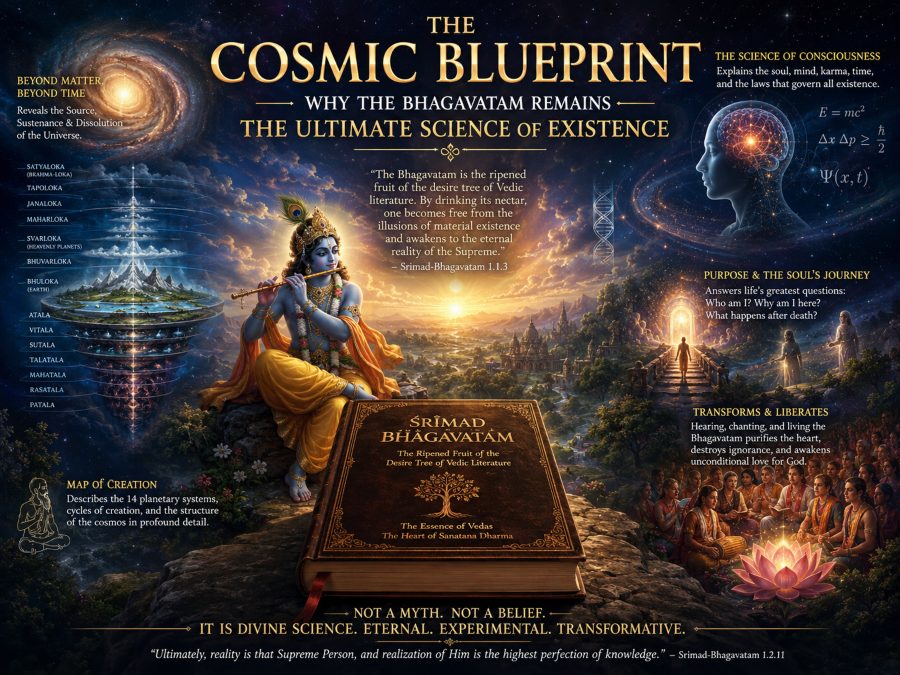
The Cosmic Blueprint: Why the Bhagavatam Remains the Ultimate Science of Existence
There is a text that has outlasted empires, silenced skeptics, and answered questions that modern physics is only beginning to ask. The Srimad Bhagavatam—composed thousands of years ago on the banks of the Sarasvati River—is not simply a religious scripture. It is a structured, layered, and breathtaking map of reality: consciousness, cosmology, time, matter, and the living soul, all woven together with a precision that continues to astonish honest seekers. For those walking this path seriously, resources like Mayapur Store offer authentic editions and study materials that connect readers to the living tradition behind this text. The Bhagavatam is not a relic of the past. It is a living document—and arguably, the most complete science of existence ever committed to language.
What Makes a Scripture “Scientific”?
Before exploring the Bhagavatam’s claim to being a science, we should agree on what science actually means. Science is not merely telescopes and test tubes. At its core, science is a systematic method of understanding reality — observation, hypothesis, verification, and transmission of knowledge across generations. By that definition, the Bhagavatam qualifies on every count.
It begins with a question—the most fundamental question a human being can ask: “What is the absolute truth?” The great sage Suta Goswami, addressing an assembly of sages at Naimisharanya, does not offer mythology as an answer. He offers a structured cosmology, a theory of time cycles, a description of the origin of matter, and a detailed account of consciousness that distinguishes the individual soul from both the material body and the supreme source of all existence.
That is not poetry dressed as philosophy. That is philosophical science dressed as poetry.
The Cosmology That Predates Modern Discovery
One of the most striking features of the Bhagavatam is its cosmological detail. Centuries before Copernicus, the text described a heliocentric-adjacent model of planetary movement. Long before Einstein articulated the relativity of time, the Bhagavatam described time moving at different speeds in different realms—including the famous story of King Kakudmi, who traveled to Brahmaloka and returned to find millions of years had passed on Earth.
Modern cosmologists speak of dark matter, multiverses, and the cyclical nature of the universe—expansion, contraction, and re-expansion. The Bhagavatam describes this through the concept of kalpas and pralayas—cosmic days and nights of Brahma, each lasting billions of years. The figures given are staggering in their scale and surprisingly consistent with contemporary estimates of the universe’s age and lifespan.
This is not coincidence. This is the result of a tradition that took the investigation of reality with absolute seriousness—not as an intellectual exercise, but as a spiritual imperative.
Read Also:- Enhancing Your Daily Sadhana with Srimad-Bhagavatam
Consciousness: The Missing Variable in Modern Science
Here is where the Bhagavatam surpasses every modern scientific framework: it accounts for consciousness.
Contemporary science is increasingly embarrassed by what philosophers call the “hard problem of consciousness.” We can map every neuron, trace every synapse, and build the most sophisticated brain-imaging technology imaginable—and still we cannot explain why there is subjective experience at all. Why does anything feel like something from the inside?
The Bhagavatam answers this directly. Consciousness is not a product of matter. Matter is a product of consciousness. The supreme conscious entity—referred to as Brahman, Paramatma, and ultimately Bhagavan—is the original source from which both matter and individual souls emerge. Each living being is a particle of that original consciousness, temporarily covered by material energy.
This is not a vague mystical claim. The Bhagavatam provides a detailed taxonomy: the five gross elements, the three subtle elements, the ten senses, the mind, intelligence, false ego—and beyond all of them, the atma, the conscious self that observes and experiences. This 24-element analysis of material existence is a precise ontological framework that Western philosophy has only partially approached through centuries of effort.
The Science of Time and Karma
The Bhagavatam treats time as one of the most formidable expressions of the divine. Kala — time — is described not as a passive backdrop to events, but as an active force that drives all change, all decay, and all transformation. Every living being moves through time under the influence of karma — the precise law of action and consequence that operates across multiple lifetimes.
This is moral physics. Just as a thrown stone follows a predictable arc, every action generates a proportional reaction — not randomly, not symbolically, but with the exactness of natural law. The Bhagavatam insists that no account is ever lost, no suffering is accidental, and no act of goodness disappears without bearing fruit. The universe, in this framework, is a perfectly just system administered by a higher intelligence.
Modern chaos theory admits that tiny causes produce enormous effects. The Bhagavatam goes further: it says that the apparently chaotic surface of existence conceals an underlying order of breathtaking precision.
The Bhakti Framework: Science With a Human Heart
What sets the Bhagavatam apart from other cosmological or philosophical systems is that it does not leave the seeker as a mere observer of reality. It invites participation.
The path of bhakti—devotional engagement with the Supreme—is described not as blind faith but as a scientific process. Srila Prabhupada, the founder-acarya of ISKCON and the person most responsible for bringing the Bhagavatam to the Western world, consistently described bhakti yoga as an exact science. The practitioner follows a method—shravanam, kirtanam, and smaranam (hearing, chanting, and remembering)—and obtains verifiable results: purification of consciousness, freedom from anxiety, and ultimately direct perception of the divine.
This is repeatable. It has been practiced and verified by millions across thousands of years, across cultures and continents. By the standards of any empirical tradition, that constitutes extraordinary evidence.
Why the Bhagavatam Remains Unmatched
Every great civilization has produced its sacred texts. The Bhagavatam stands apart not because it is Hindu or Indian or ancient, but because of what it actually contains. No other text simultaneously addresses:
- The origin and structure of the universe
- The nature and mechanics of time
- The ontology of consciousness and matter
- The psychology of the human condition
- The mechanics of karma across lifetimes
- The practical path to liberation from suffering
- The nature of the Absolute Truth in personal and impersonal dimensions
The Bhagavatam does all of this in twelve cantos comprising eighteen thousand verses—each word chosen with a precision that has sustained centuries of commentary, debate, and deepening discovery.
A Blueprint, Not Just a Book
The word “blueprint” is apt. A blueprint is not the building itself — it is the precise technical document that makes the building possible. The Bhagavatam is a blueprint for understanding existence: where it comes from, how it operates, what the individual soul’s relationship to the whole truly is, and where the entire story is ultimately headed.
Modern science has given humanity extraordinary tools. It has conquered disease, mapped the genome, and sent machines beyond the solar system. But it has not answered the questions that keep human beings awake at night: Why am I here? What happens when I die? Does anything actually matter?
The Bhagavatam answers all three—not with comfort, but with knowledge. And knowledge, when it is real, is the most liberating force in existence.
That is why, thousands of years after its composition, the Srimad Bhagavatam remains not just relevant but essential. It is the cosmic blueprint that the world keeps rediscovering—because reality, however deeply you dig into it, keeps pointing back to the same source.
Begin your journey with a quality edition of the Srimad Bhagavatam and explore supporting study resources at Mayapur Store—a trusted destination for authentic Vaishnava literature and devotional goods.
 VedSoul – Vedic Wisdom for the Modern Soul