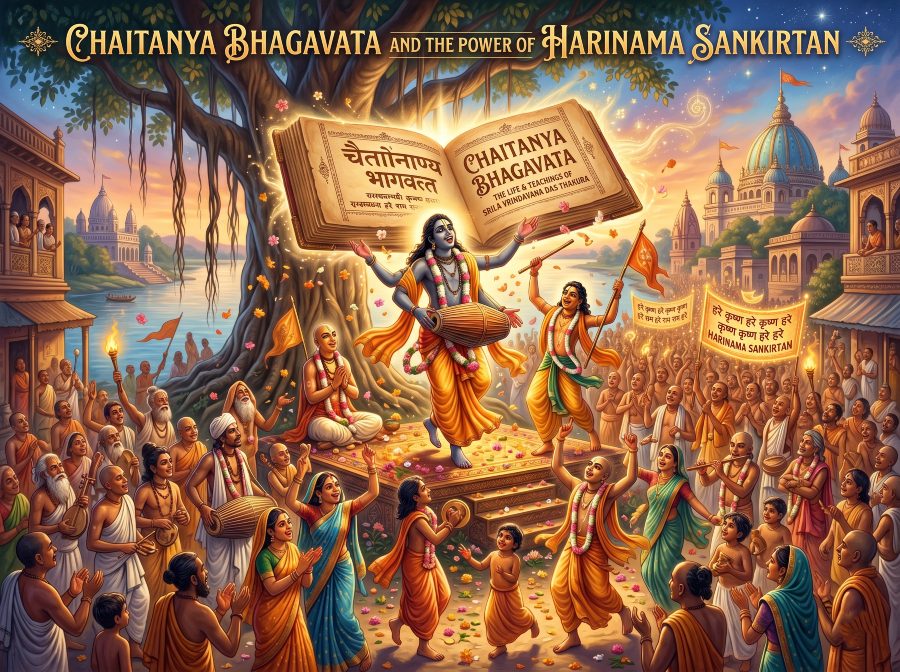
Chaitanya Bhagavata and the Power of Harinama Sankirtan
There are certain scriptures in the Vaishnava tradition that do not merely inform the reader — they transform the reader. The Chaitanya Bhagavata, composed by Srila Vrindavana Dasa Thakura in the sixteenth century, is one such text. At its very core is a truth so luminous and so urgent that it leaps off every page: the chanting of the holy name of God — Harinama Sankirtan — is not one spiritual path among many. It is the only path specifically designed for the souls of Kali-yuga. Readers who wish to explore this sacred text can find it at the Mayapur Store, where it is available for study and personal devotional practice.
This article explores how the Chaitanya Bhagavata presents Harinama Sankirtan — not as a cultural tradition or a ritualistic formality, but as the living, breathing heartbeat of the entire Chaitanya movement. Through narrative, theology, and the power of direct personal example, Vrindavana Dasa Thakura shows us precisely why Sri Chaitanya Mahaprabhu descended into this world and what He came to give.
What Is Harinama Sankirtan? Understanding the Term
Before entering the theology of the Chaitanya Bhagavata, it helps to understand what Harinama Sankirtan actually means. The word ‘Harinama’ simply means ‘the name of Hari’ — that is, the holy name of God. ‘Sankirtan’ derives from the Sanskrit root ‘kirt,’ meaning to glorify or proclaim, with the prefix ‘sam’ indicating completeness or totality. Together, Harinama Sankirtan means the complete, wholehearted, congregational glorification of God’s holy name.
This is not silent meditation, solitary japa alone, or the exclusive province of the learned. Sankirtan, by its very definition, is communal, vocal, joyful, and all-inclusive. It fills the streets. It shakes the walls of temples. It brings tears to the eyes of those who have never cried in prayer. And according to the Chaitanya Bhagavata, it is precisely this quality — its universality, its openness, its infectious spiritual joy — that makes it the perfect medicine for the age of Kali, an age characterized by quarrel, hypocrisy, shortened lifespan, and diminished spiritual capacity.
Lord Chaitanya as the Avatar of Sankirtan
The Chaitanya Bhagavata opens with an unambiguous theological declaration: Sri Chaitanya Mahaprabhu is Krishna Himself, the Supreme Personality of Godhead, appearing in the form of a devotee to personally demonstrate and distribute the path of bhakti through Harinama Sankirtan. This is not presented as speculation or sectarian opinion. Vrindavana Dasa Thakura grounds this claim in scriptural evidence, citing verses from the Srimad Bhagavatam and other Vedic texts that predict the appearance of a golden-complexioned avatara in the age of Kali who will spread the chanting of the holy name.
What makes this extraordinary is that Lord Chaitanya does not simply teach Harinama Sankirtan — He lives it with every cell of His being. He weeps while chanting. He falls unconscious in ecstasy. He runs through the streets of Navadvipa calling out the names of Krishna as if separated from his dearest friend. In depicting these pastimes, Vrindavana Dasa Thakura is telling us something profound: the holy name is not merely a spiritual technique. It is an expression of the deepest possible love between the soul and God.
The Navadvipa Sankirtan Movement — A Revolution in Bhakti
One of the most vivid and historically significant portions of the Chaitanya Bhagavata is its account of the Navadvipa sankirtan movement. When Lord Chaitanya returned from Gaya after receiving initiation from Ishvara Puri, He was completely transformed. The dry grammar teacher became an ocean of love for Krishna. He gathered His associates — Nityananda Prabhu, Advaita Acharya, Srivasa Thakura, Haridasa Thakura, Gadadhara Pandita, and many others — and began conducting massive nighttime kirtans in the courtyard of Srivasa Thakura, a gathering later known as the Srivasa Angan.
Vrindavana Dasa Thakura describes these kirtans with breathtaking devotional intensity. The chanting would go on through the night, filling the neighborhood with divine sound. Devotees danced and wept in turns. Lord Chaitanya would manifest the eight ecstatic symptoms — trembling, perspiration, horripilation, tears, faltering voice, pallor, stupefaction, and unconsciousness — not as performance but as the natural overflow of a heart completely saturated with love of God.
This was radical for its time. Sixteenth-century Bengal was stratified by caste, weighted down by ritual formalism, and largely cut off from the direct experience of devotion. The Navadvipa sankirtan movement shattered these barriers. Rich and poor, learned and illiterate, high-caste and low-caste — all were welcome in the kirtan. The only qualification was a sincere heart. This, Vrindavana Dasa Thakura insists, is the genius and the grace of Harinama Sankirtan — it belongs to everyone.
Haridasa Thakura — The Namacharya and the Power of the Name
No discussion of Harinama Sankirtan in the Chaitanya Bhagavata is complete without reflecting on the figure of Haridasa Thakura — the Namacharya, or the supreme teacher of the holy name. Born into a Muslim family in Bengal, Haridasa Thakura had no conventional Vaishnava lineage, no caste standing, no Sanskrit education. What he had was an absolute, unshakeable, all-consuming love for the holy name of Krishna.
Vrindavana Dasa Thakura describes how Haridasa Thakura chanted three hundred thousand names of God daily — a practice so total, so single-pointed, and so joyful that it made the birds go quiet, the insects stop moving, and even his persecutors eventually bow in reverence. He was beaten publicly, dragged through the market, thrown into the river — and he emerged from every ordeal chanting. The holy name was not his practice. It was his life, his breath, his very identity.
By placing Haridasa Thakura at the very center of the sankirtan movement despite all conventional disqualifications, the Chaitanya Bhagavata makes a statement that echoes across every page of the text: the holy name recognizes no human boundaries. Caste, birth, gender, past sinful history — none of these can obstruct the mercy of the name when the heart is truly open. This is the revolutionary theology of Harinama Sankirtan as Vrindavana Dasa Thakura presents it.
The Mercy of Jagai and Madhai — Sankirtan’s Power to Purify
Perhaps no episode in the entire Chaitanya Bhagavata illustrates the transformative power of Harinama Sankirtan more dramatically than the deliverance of Jagai and Madhai. These two brothers were the worst of their kind — habitual drunkards, violent criminals, and public menaces whom the entire neighborhood of Navadvipa feared and avoided. When Nityananda Prabhu and Haridas Thakura approached them with the gift of the holy name, Madhai responded by hurling a clay pot at Nityananda Prabhu, drawing blood from his forehead.
Lord Chaitanya, witnessing the bleeding of His dearest associate, raised His Sudarshana Chakra in divine fury. It was Nityananda Prabhu Himself — the very one who had just been wounded — who intervened, begging the Lord to spare them, arguing that the deliverance of the most fallen is the highest glory of the sankirtan movement. This single act of forgiveness melted Madhai completely. The two brothers fell at the Lord’s feet, were embraced, and were transformed from the inside out — not by punishment, not by philosophical argument, but by the unconditional mercy that flows through the vehicle of Harinama Sankirtan.
Vrindavana Dasa Thakura lingers on this episode because it encapsulates his entire message. The holy name is not a reward for the righteous. It is the rescue rope thrown to those drowning in the ocean of material existence. The lower one has fallen, the more urgently the mercy of the sankirtan movement applies.
Why Harinama Sankirtan Is the Yuga-Dharma of Kali-Yuga
The Chaitanya Bhagavata repeatedly returns to a central Vedic teaching: every age has its prescribed dharma, its recommended path of spiritual realization. In the Satya-yuga, the practice was deep meditation. In Treta-yuga, it was elaborate fire sacrifices. In Dvapara-yuga, it was formal temple worship. And in Kali-yuga — the current age of darkness, hypocrisy, and shortened human lifespan — the single prescribed dharma is Harinama Sankirtan: the congregational chanting of the holy name.
Vrindavana Dasa Thakura does not present this as a consolation prize for souls too weak for higher practices. He presents it as the most powerful of all the yuga-dharmas — the one that accomplishes in minutes what meditation could not accomplish in thousands of years. He quotes the famous Srimad Bhagavatam verse that declares the holy name to be the greatest treasure of Kali-yuga, the one auspicious element in an otherwise degraded age. Lord Chaitanya did not give humanity a lesser path. He gave it the greatest path, disguised in the simplest form.
Conclusion: The Chaitanya Bhagavata’s Eternal Call to Chant
The Chaitanya Bhagavata is, at its heart, an extended love letter to the holy name. Every episode, every theological argument, every tear shed by a devotee in the pages of this scripture points toward the same inescapable conclusion: nothing in this world or the next is more valuable than the sound of God’s name rising from a sincere human heart.
Srila Vrindavana Dasa Thakura wrote with the urgency of someone who had seen what the holy name could do — to individuals, to communities, to the social fabric of an entire region. He had seen the most fallen souls transformed in a single evening of kirtan. He had witnessed the ecstasies of Lord Chaitanya and His associates as they chanted through the night in Navadvipa. And he poured all of that living, breathing, tear-soaked testimony into this scripture so that every soul born after him could receive the same invitation.
The invitation is still open. The kirtan is still going. And the Chaitanya Bhagavata — available today through the dedicated efforts of Vaishnava institutions worldwide — remains the most powerful written testimony to what happens when human beings stop everything and simply chant the names of God together. That is Harinama Sankirtan. That is the gift of Lord Chaitanya. And that is why this scripture, written five centuries ago in a village in Bengal, still has the power to change lives today.
— Hare Krishna Hare Krishna Krishna Krishna Hare Hare | Hare Rama Hare Rama Rama Rama Hare Hare —
 VedSoul – Vedic Wisdom for the Modern Soul