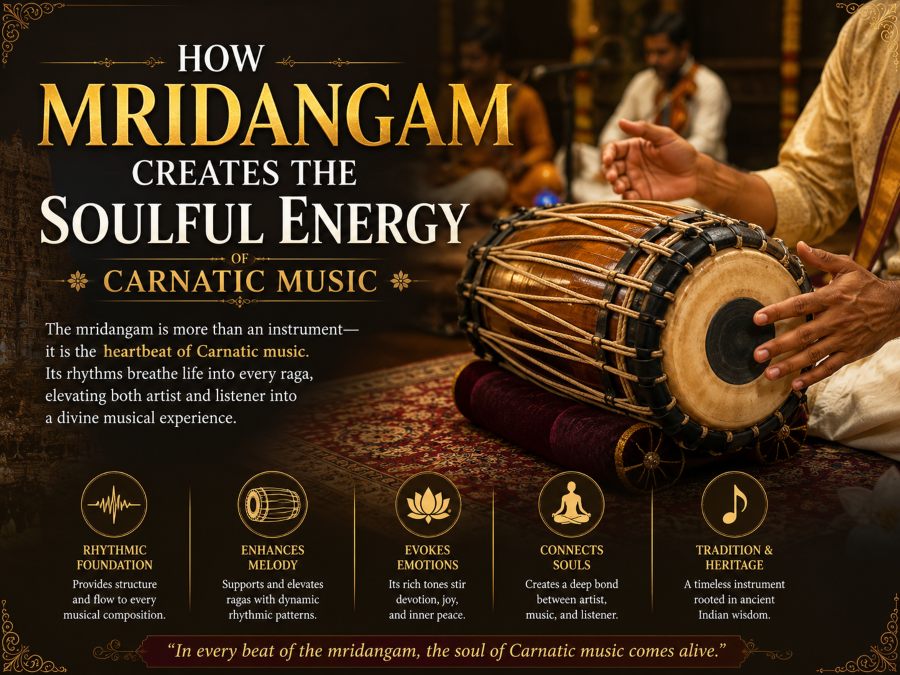
How Mridangam Creates the Soulful Energy of Carnatic Music
By a music enthusiast who has spent years sitting cross-legged in sabhas, listening to the mridangam breathe life into ragas.
There’s a moment in every Carnatic concert when the mridangam player leans forward slightly, closes his eyes, and his fingers begin to speak. Not just beat — speak. The audience shifts. The air changes. Something ancient wakes up in the room.
That’s the mridangam doing what it has done for over two thousand years: carrying the heartbeat of an entire musical tradition on its two drumheads.
This article is about that mridangam instrument — where it comes from, how it works, and why no Carnatic performance ever feels complete without it.
What Exactly Is the Mridangam?
The mridangam is a double-headed barrel drum. It sits horizontally across the player’s lap, with one end—the thoppi or bass side—facing left and the other end—the valanthalai or treble side—facing right.
That’s the simple version. The real version is far more interesting.
The drum is carved from a single piece of jackwood. Not assembled. Carved—hollowed out from one solid log so the resonance chamber is seamless. The two heads are made from layered animal skin, each with a permanently applied black paste in the center called the “suro” or “karanai.” This paste — made from rice, iron filings, and other materials depending on the tradition — is what gives the mridangam its characteristic pitched tone. No other drum in the world works quite like this.
And here’s what most people don’t realize: the mridangam is a tuned percussion instrument. Before every performance, the player strikes the rim with a small wooden hammer, tightening or loosening the leather straps that cross the body of the drum. They’re not just warming up — they’re tuning the instrument to match the sruti (pitch) of the vocalist or lead instrumentalist. The treble side is tuned to the tonic of the main performer.
That’s a level of musical sensitivity most rhythm instruments don’t even attempt.
A History That Goes Back to the Gods
Ask any traditional Carnatic musician about the mridangam’s origin, and they’ll likely smile and say: it came from Lord Ganesha.
The mythological story goes that Brahma, the creator, wanted music to honor the universe he had made. Vishwakarma, the divine architect, carved the mridangam from clay (mrid = clay, anga = body — though this etymology is debated). Ganesha played it at the first cosmic performance.
Beyond mythology, the mridangam appears in ancient Tamil Sangam literature — poetry composed roughly between 300 BCE and 300 CE. The pari drum, referenced in these texts, is considered a predecessor. By the time of the Natyashastra (Bharata Muni’s treatise on performing arts, dated anywhere from 200 BCE to 200 CE), the pushkara family of drums — of which the mridangam is a prominent member — was well documented.
Temple sculptures across South India, particularly in Tamil Nadu, show mridangam players in relief panels dating back over a thousand years. The instrument wasn’t just popular — it was sacred.
What’s remarkable is how little the fundamental design has changed. The mridangam being played at a concert in Chennai today would be recognizable — in form if not in refinement — to a musician from the 10th century.
The Science Hidden Inside the Sound
Let’s talk about what actually happens when a mridangam player strikes the drum. Because it’s not what you think.
The Two Heads and What They Do
The valanthalai (right/treble head):
- Smaller in diameter
- Has the permanent black patch (soru) in the center
- Produces high, clear tones—from sharp “ta” sounds to resonant, pitched notes
- This is the head that gets tuned to the sruti
- The player uses the right hand primarily on this side
The thoppi (left/bass head):
- Larger in diameter
- Has a removable paste applied before playing—traditionally semolina and water, sometimes called “kanji”
- Produces deep, bass-heavy sounds
- Gives the mridangam its distinctive low-frequency rumble
- The player uses the left hand primarily on this side
The interplay between these two heads creates the mridangam’s characteristic texture: a blend of treble clarity and bass depth that no single-headed drum can replicate.
The Acoustic Physics
What makes the mridangam’s treble head scientifically unusual is that the black patch shifts the drum’s overtones into near-harmonic frequencies. Most drumheads produce inharmonic overtones—sounds that don’t align with the musical scale. The mridangam’s soru patch suppresses certain overtones and emphasizes others, so the drum produces pitches that feel musical rather than just percussive.
This is why a skilled mridangam player can suggest a raga through rhythm alone. The tonal quality of the instrument connects it to the melodic world.
The Grammar of Mridangam: Understanding Tala
To understand the mridangam’s role, you first need to understand tala — the rhythmic cycle that governs Carnatic music.
Tala is not simply a time signature. It is a living, cycling structure with specific internal subdivisions called angas. The most common tala in Carnatic music is Adi tala—eight beats, divided into groups of 4 + 2 + 2. But there are dozens of talas, some spanning as many as 128 beats.
The vocalist or main instrumentalist keeps tala by clapping and waving the hand—an action called “kriya.” The mridangam player must not only maintain this cycle perfectly but also ornament it, emphasize its structure, and eventually break into elaborate improvisatory passages called “korvais” and “kalpana svaras” that return precisely to the beginning of the tala cycle—no matter how far they’ve wandered.
This is the art: freedom within absolute precision.
The Syllable Language of the Mridangam
Every stroke on the mridangam has a name — a spoken syllable. These syllables collectively form solkattu (also called konnakol), the vocalized language of South Indian rhythm.
Some basic strokes:
- Ta — sharp right-hand strike on the center of the treble head
- Di — open resonant right-hand stroke
- Tha — flat palm on the treble head, muting the sound
- Nam—combination of left bass and right treble
- Thom — deep bass note on the left head with sustained resonance
- Ka — light left-hand finger stroke
Combine these syllables and you build rhythmic phrases: ta-ka-di-mi, tha-ka-tha-ri-ki-ta, na-ka-di-mi-ta-ka-jo-nu. A mridangam player must be able to speak and play these phrases simultaneously—a practice that forms the backbone of their training.
When you hear a performer vocalizing these syllables while drumming, they’re not just performing—they’re thinking in rhythm’s native tongue.
The Mridangam Player’s Role in a Carnatic Concert
Walk into a typical Carnatic kutcheri (concert), and here’s what you’ll see on stage:
- The main performer — vocalist or violinist or veena player — at the center
- A violinist (if the main performer isn’t a violinist) for melodic accompaniment
- A mridangam player, slightly to the side and behind
- Sometimes a ghatam (clay pot), kanjira (frame drum), or morsing (jaw harp) player
The mridangam player is the rhythmic anchor. Everything locks onto them.
Three Phases of Involvement
Phase 1 — Supporting the melody
In the early stages of a composition, the mridangam plays softly and supportively. The focus is on the melody. The drummer’s job is to keep the tala steady, provide a rhythmic cushion, and make space for the vocalist or instrumentalist to breathe and ornament.
Phase 2 — Building momentum
As a composition reaches its more elaborate sections—particularly the niraval and kalpana svara improvisation—the mridangam becomes more active. The player starts offering rhythmic commentary, calling and responding to the main performer’s melodic choices.
Phase 3—The tani avartanam
This is the mridangam’s big moment. Literally translating to “solo round,” the tani avartanam is a section where the main performer steps back and the percussion ensemble takes center stage.
A skilled mridangam player’s tani can last anywhere from five minutes to half an hour. They will explore every corner of the tala—playing in unusual subdivisions (nadai), constructing complex rhythmic patterns that span multiple cycles, and building tension through long mora (three-repeat patterns) that resolve in a single, unanimous cadence.
When done well, the tani avartanam doesn’t just showcase technique. It tells a story.
What Makes a Great Mridangam Player?
There are many technically proficient mridangam players. But the ones who become legends—the ones whose tani you still talk about years later—have something beyond skill.
Sruti Suddham (Pitch Purity)
A mridangam player’s treble head must ring true to the concert’s sruti at all times. Weather affects the instrument. Temperature affects it. Humidity affects it. A great player is constantly aware of this and makes micro adjustments through the way they strike and pressure the drum.
Laya Gnana (Rhythmic Wisdom)
This goes beyond just keeping time. Laya gnana is the deep understanding of where you are in a rhythmic cycle at every moment—and, more importantly, how to manipulate that awareness to create anticipation, surprise, and resolution.
A player with laya gnana can make an eight-beat tala feel like it has infinite space.
Sahitya Anugunam (Sensitivity to Lyrics)
When accompanying a vocalist, the mridangam player must listen to the words being sung. Different syllables and phrases in the lyric carry different emotional weights. A great player’s drumming will subtly shift in character when the lyric speaks of devotion versus longing versus celebration.
This is the most underrated skill in mridangam playing—and the one that separates good players from transcendent ones.
Conversation on Stage
Carnatic music is a live conversation. The main performer makes a musical statement; the accompanists respond. In the improvisatory sections, this conversation becomes explicit: the vocalist sings a rhythmic phrase; the mridangam echoes it back with a slight variation; the exchange continues until both arrive at the same place simultaneously.
Watch the faces of great performers during these exchanges. You’ll see pure joy.
The Training: Years of Hand Memory
Learning the mridangam is not quick. There’s no shortcut.
A student typically begins by learning to vocalize solkattu—speaking the rhythmic syllables clearly and accurately in complex patterns before ever touching the drum. This can go on for months.
Then begins the work of building hand technique. Each finger develops specific roles. The right index finger and middle finger handle different strokes. The left hand’s palm must deliver both open bass notes and muted tones. Finger independence, wrist flexibility, and shoulder relaxation all matter.
The real training happens in the gurukula tradition—studying under a master, sometimes living in their household, absorbing not just technique but aesthetic understanding. The major lineages of mridangam playing include the following:
- Pudukkottai style — known for subtle nuance and restraint
- Thanjavur style — known for robust sound and bold playing
- Palani style — known for medium weight with expressive improvisation
Each style has its own repertoire of patterns, preferred stroke techniques, and aesthetic values. A student doesn’t just learn to play—they learn to think in a particular tradition.
Serious students typically spend five to ten years before performing professionally. The finest players often look back at forty years of practice and still feel they are learning.
The Mridangam in the Larger Percussion Ensemble
At larger concerts and during the tani avartanam, the mridangam is often joined by other percussion instruments. This creates a rhythmic conversation between players—the layavinyas, or rhythmic design—that is one of Carnatic music’s great pleasures.
The Ghatam
A large clay pot played with the fingers, palms, and even the wrists against the open mouth. The ghatam produces a range of sharp, bright sounds that contrast beautifully with the mridangam’s rounder tones. Playing the ghatam at a high level requires extraordinary hand control—the pot is unforgiving to a misplaced strike.
The Kanjira
A small frame drum—like a tambourine without the jingling discs, made with a monitor lizard skin head. The kanjira is capable of astonishing speed and precision. A kanjira player following a mridangam in a fast tani passage is one of Carnatic music’s most exciting sights.
The Morsing
A jaw harp is played by holding the metal frame between the teeth and plucking the vibrating tongue with a finger. Its sound is buzzy and hypnotic. In the right hands, the morsing adds a texture to the ensemble that no other instrument can replicate.
Together, these instruments don’t simply add volume. They create a multi-layered rhythmic tapestry, with each player listening carefully and responding to the others.
Famous Mridangam Masters Who Shaped the Tradition
Any article about the mridangam is incomplete without acknowledging the giants who shaped how the instrument sounds today.
Palghat Mani Iyer (1912–1981) — Widely considered the greatest mridangam player of the 20th century. His playing was architectural: perfectly structured, built with patience, resolving with inevitable elegance. He accompanied virtually every legend of his generation and set a standard that still defines the instrument.
Palani Subramania Pillai (1908–1962) — The founder of what became the Palani school of playing. His recordings reveal a player of extraordinary depth and emotional sensitivity. He died young, but his influence never diminished.
Umayalpuram K. Sivaraman—One of the most recorded mridangam players in history. His versatility — equally at home in classical Carnatic settings, Hindustani collaborations, and global fusion — made him a bridge between worlds.
T.V. Gopalakrishnan—Known as TVG, he is not only a master mridangam player but also a vocalist and teacher who has written extensively on rhythm theory. His ability to articulate and codify the principles of Carnatic rhythm has made him invaluable to the tradition.
Trichy Sankaran — A Chennai-born master who spent much of his career in Canada, teaching Carnatic rhythm to a global audience and influencing generations of non-Indian percussionists.
Why the Mridangam Feels Like It Has a Soul
Here’s the part that’s hardest to explain in technical terms.
When you sit in a concert and close your eyes during a tani avartanam, something happens that goes beyond rhythm. The mridangam—at its best—doesn’t just mark time. It inhabits it. The silences between strokes feel as meaningful as the strokes themselves. The buildup of a moral toward its resolution creates real suspense. The release, when it comes, produces something very close to physical pleasure.
This has something to do with the instrument’s tonal quality—that near-harmonic pitch from the tuned treble head. It has something to do with the tradition of improvisation, which means every performance is genuinely unique. It has something to do with the way great players listen—not just to the beat they’re playing, but to the entire sonic environment around them.
But honestly? Some of it is just mystery. The mridangam is one of those instruments that crosses the line between tool and voice.
The Mridangam in the Modern World
The 21st century has been both kind and complicated to the mridangam.
On one hand, the instrument has never been more accessible. Recordings of the great masters are available to anyone with a phone. Online teaching has allowed students in places far from Tamil Nadu to learn solkattu and basic technique. International percussion festivals regularly feature mridangam players, and collaborations with jazz drummers, West African percussionists, and electronic musicians have pushed the instrument into new sonic territory.
On the other hand, the time demands of serious mridangam training remain what they always were. Five to ten years of daily practice doesn’t compress. The gurukula system—with its emphasis on oral transmission and direct student-teacher relationship—is harder to sustain in a world of compressed schedules.
The players doing the most interesting work today are those who honor both sides of this tension: deeply trained in the tradition while open to where the instrument might go next.
How to Listen to the Mridangam: A Practical Guide
If you’re new to Carnatic music, here’s how to start engaging with the mridangam specifically:
Start with tani avartanam recordings. Solo percussion segments give you the instrument in full focus, without having to follow the melody simultaneously. Search for recordings by Palghat Mani Iyer or Umayalpuram Sivaraman to start.
Learn to count the tala. Pick Adi tala (8 beats) and count along: clap on 1, wave right on 5, wave right on 7. Once you can count through a performance, you’ll start to feel how the mridangam plays with and against the cycle.
Notice the silence. In a great mridangam performance, the gaps between strokes are as musical as the strokes. Try listening to the space.
Watch live if possible. The physical vocabulary of mridangam playing — the balance of the body, the particular way each hand approaches the drum, the facial expressions during concentration — adds enormous dimension to the sound.
The Mridangam Is Not Just an Instrument. It’s a Philosophy.
Carnatic music teaches that melody (raga) and rhythm (tala) are inseparable aspects of one reality. Neither dominates. Neither disappears. They breathe together.
The mridangam embodies this teaching physically. It is simultaneously a percussion instrument and a pitched instrument. It keeps time and transcends time. It supports the main performer and has its own complete, profound voice.
When a mridangam player and a vocalist or violinist are truly in conversation—when the exchange becomes effortless and intuitive and alive—you’re witnessing one of the most sophisticated forms of musical communication that human beings have developed. Two people, one rhythm, infinite space.
That’s what the mridangam does. It creates the soulful energy of Carnatic music not by adding something from outside but by revealing what was always already there: the pulse beneath the melody, the silence beneath the sound, the present moment beneath all the accumulated history.
Final Thought
Next time you hear a Carnatic concert—live or recorded—pay attention to the mridangam player. Not just during the tani avartanam. Throughout.
Watch how they listen. Notice the small adjustments of pressure and angle. Observe how their energy changes when the main performer moves into an emotional passage. See how they set up moments for the soloist to land on.
The mridangam player is not the loudest person on the stage. But take them away, and something irreplaceable leaves the room.
That’s the nature of a heartbeat.
 VedSoul – Vedic Wisdom for the Modern Soul