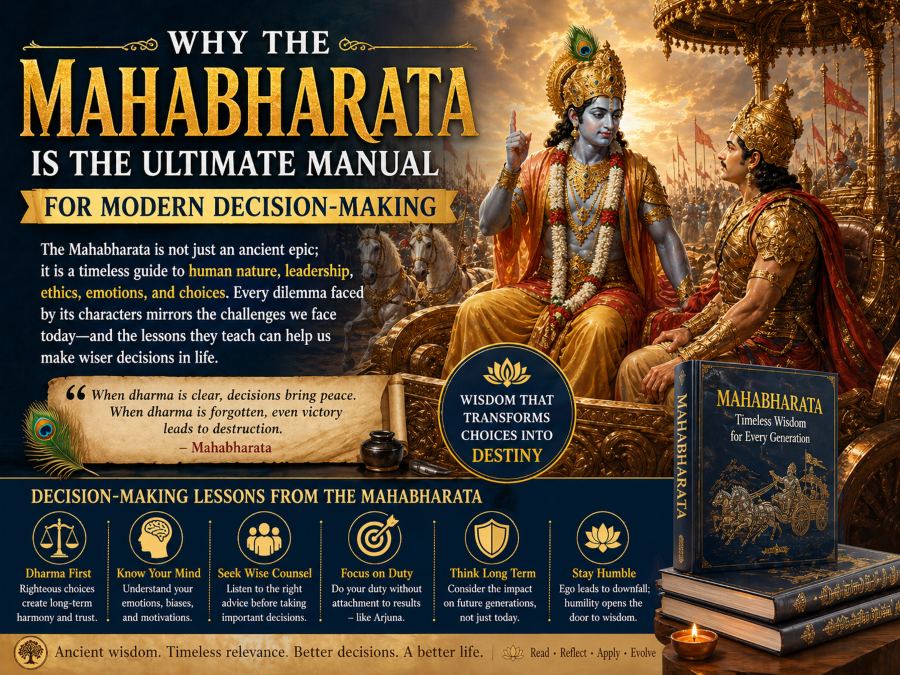
In an age filled with uncertainty, emotional pressure, ethical confusion, and constant competition, people are increasingly searching for timeless wisdom to guide their choices. The ancient Indian epic Mahabharata remains one of the most powerful resources for understanding human behavior, leadership, morality, and practical intelligence. Readers exploring Decision making lessons from Mahabharata often discover that this sacred epic is far more than mythology — it is a living guide for navigating modern life with clarity and wisdom.
The Mahabharata addresses dilemmas that still exist today: workplace politics, family disputes, leadership failures, emotional struggles, ethical compromise, ambition, loyalty, justice, and spiritual confusion. Every major character in the epic faces difficult decisions, and the consequences of those choices form the foundation of its timeless teachings.
Mahabharata Beyond the Battlefield
Many people view the Mahabharata primarily as a story about war between the Pandavas and the Kauravas. While the Kurukshetra battle is central to the narrative, the deeper essence of the epic lies in its exploration of human decision-making.
The Mahabharata constantly asks difficult questions:
- What is the right thing to do in morally complex situations?
- Should loyalty come before truth?
- How should leaders respond to injustice?
- Can emotional attachment cloud judgment?
- What happens when ambition overrides ethics?
Unlike simplistic stories that divide characters into purely good or evil categories, the Mahabharata presents deeply human personalities. Even noble individuals make mistakes, while flawed people occasionally display greatness. This realism is precisely why the epic remains so relevant today.
Modern life is filled with gray areas rather than absolute certainties. The Mahabharata prepares readers to think deeply before acting and to understand the long-term consequences of every decision.
Decision-Making and the Concept of Dharma
One of the central themes of the Mahabharata is dharma — the principle of righteous conduct and moral responsibility. However, the epic shows that dharma is not always obvious or easy to follow.
Different characters interpret duty differently based on their position, relationships, and emotional attachments. This complexity mirrors modern life, where individuals often struggle to balance personal desires, professional obligations, family expectations, and ethical standards.
The Mahabharata teaches that wise decision-making requires:
- Self-awareness
- Emotional discipline
- Ethical reflection
- Long-term thinking
- Spiritual understanding
The epic repeatedly demonstrates that decisions made purely from ego, anger, greed, or insecurity eventually create suffering.
Yudhishthira and Ethical Leadership
Yudhishthira, the eldest Pandava, is often considered the embodiment of righteousness. His decisions throughout the epic provide powerful lessons for modern leaders, executives, educators, and policymakers.
Integrity Matters More Than Immediate Gain
Yudhishthira values truth and fairness even when doing so creates personal hardship. In today’s competitive environment, many people compromise ethics for short-term success. The Mahabharata warns that such victories are temporary and ultimately destructive.
Modern organizations frequently collapse due to unethical decision-making:
- Financial fraud
- Abuse of power
- Manipulation
- Corruption
- Dishonesty
Yudhishthira’s character reminds us that credibility and trust are long-term assets.
Overthinking Can Also Become Weakness
At the same time, the Mahabharata does not portray Yudhishthira as perfect. His excessive attachment to morality sometimes delays necessary action. His participation in the dice game becomes a catastrophic mistake.
This teaches an important modern lesson: ethical behavior must be combined with practical wisdom and situational awareness. Good intentions alone are not enough.
Arjuna’s Crisis: Emotional Intelligence in Decision-Making
One of the most profound moments in the Mahabharata occurs when Arjuna collapses emotionally before the Kurukshetra War. Faced with the reality of fighting relatives, teachers, and loved ones, he becomes overwhelmed by doubt and grief.
This emotional crisis is deeply relatable today.
People often struggle with:
- Career decisions
- Family responsibilities
- Relationship conflicts
- Moral uncertainty
- Emotional burnout
- Fear of consequences
Arjuna’s confusion represents the psychological paralysis that many individuals experience when facing major life decisions.
Krishna’s Guidance and Mental Clarity
Lord Krishna’s teachings to Arjuna in the Bhagavad Gita form one of the greatest guides to decision-making ever written.
Krishna explains that clarity emerges when a person rises above:
- Fear
- Ego
- Attachment
- Emotional impulsiveness
- Desire for external validation
He teaches Arjuna to focus on duty rather than anxiety about outcomes.
This principle remains incredibly valuable in modern life. Many people delay important decisions because they become obsessed with:
- Public opinion
- Fear of failure
- Emotional discomfort
- Future uncertainty
Krishna’s wisdom encourages action rooted in purpose, responsibility, and inner stability.
The Danger of Ego-Driven Decisions
Duryodhana represents one of the clearest examples of destructive decision-making fueled by ego and jealousy.
Despite receiving repeated opportunities for peace, he refuses compromise because his pride cannot tolerate sharing power with the Pandavas.
His downfall highlights several timeless truths:
- Ego blinds judgment
- Envy destroys rational thinking
- Insecurity creates aggression
- Pride isolates leaders from wise advice
In modern society, countless personal and professional conflicts arise because individuals prioritize ego over resolution.
Businesses collapse, relationships fail, and political systems become unstable when leaders refuse humility and self-reflection.
The Mahabharata repeatedly shows that ego-driven decisions rarely produce lasting success.
Vidura: The Voice of Practical Wisdom
Vidura is one of the wisest advisors in the Mahabharata. Calm, intelligent, ethical, and strategic, he consistently offers balanced counsel during times of crisis.
However, many leaders ignore his advice because it conflicts with their desires.
This pattern continues today. Organizations often fail not because wise guidance is unavailable, but because decision-makers reject uncomfortable truths.
Vidura teaches several key principles:
- Listen carefully before reacting
- Avoid emotional impulsiveness
- Think long term
- Surround yourself with honest advisors
- Accept criticism constructively
In modern leadership, emotional maturity and openness to feedback are essential for sustainable success.
The Dice Game: A Lesson in Psychological Manipulation
The infamous dice game in the Mahabharata serves as a powerful study of manipulation, addiction, pride, and poor judgment.
Yudhishthira continues gambling despite recognizing the danger. Shakuni exploits emotional weakness and strategic vulnerability to destroy the Pandavas politically.
Today, similar patterns appear in:
- Risky financial behavior
- Toxic business deals
- Emotional manipulation
- Online scams
- Addictive decision patterns
The Mahabharata warns against making major decisions while emotionally compromised.
It also teaches the importance of recognizing manipulation early before irreversible damage occurs.
Bhishma’s Silence and Moral Responsibility
Bhishma is among the most respected figures in the epic. Yet one of his greatest failures is remaining silent during Draupadi’s humiliation in the royal court.
This moment teaches a critical lesson:
Neutrality during injustice can become a form of participation.
In modern life, many people witness unethical behavior but avoid speaking out due to fear, loyalty, or convenience.
The Mahabharata challenges readers to ask:
- When should silence end?
- What responsibilities come with power?
- Is passive observation morally acceptable?
These questions remain deeply relevant in workplaces, governments, educational institutions, and social systems.
Draupadi and Resilience Under Pressure
Draupadi’s life demonstrates emotional resilience, dignity, and spiritual strength.
Despite facing humiliation, exile, trauma, and injustice, she refuses to surrender internally. Her faith and determination become sources of empowerment rather than weakness.
Modern readers can learn important lessons from her character:
- Pain should not destroy self-respect
- Emotional suffering can deepen wisdom
- Inner strength matters more than public approval
- Spiritual grounding helps during crises
In an era of mental stress and emotional instability, Draupadi’s resilience remains profoundly inspiring.
Karna and the Complexity of Loyalty
Karna is one of the most tragic and complex figures in the Mahabharata.
Rejected socially despite his extraordinary abilities, he remains loyal to Duryodhana because Duryodhana gave him dignity and acceptance.
However, this loyalty eventually places Karna on the side of injustice.
His life raises difficult ethical questions:
- Should gratitude override morality?
- Can personal loyalty justify harmful actions?
- What happens when emotional bonds conflict with truth?
Modern professionals often face similar dilemmas:
- Supporting unethical leadership
- Staying silent in toxic environments
- Prioritizing loyalty over ethics
The Mahabharata encourages thoughtful examination of such conflicts rather than simplistic judgment.
Strategic Thinking in the Mahabharata
The Mahabharata is also an extraordinary manual of strategy and political intelligence.
Krishna repeatedly demonstrates:
- Timing
- Psychological insight
- Negotiation skills
- Risk assessment
- Conflict management
He understands that idealism without realism can become ineffective.
Modern decision-makers must similarly balance:
- Ethics with practicality
- Vision with execution
- Compassion with discipline
- Patience with decisive action
The epic teaches that wisdom involves understanding both human psychology and long-term consequences.
Emotional Control and Rational Judgment
Many disasters in the Mahabharata occur because characters lose control over emotions.
Examples include:
- Duryodhana’s jealousy
- Ashwatthama’s rage
- Dhritarashtra’s attachment
- Shakuni’s vengeance
These emotional states cloud judgment and lead to catastrophic decisions.
Modern neuroscience and psychology strongly support this insight. Emotional impulsiveness frequently damages:
- Careers
- Relationships
- Financial stability
- Leadership credibility
The Mahabharata repeatedly emphasizes self-control as a foundation for wise action.
Lessons for Business and Leadership
The Mahabharata contains surprisingly modern insights into organizational behavior and leadership.
Leadership Requires Accountability
Leaders who avoid responsibility create instability. Dhritarashtra’s inability to discipline Duryodhana eventually destroys the entire kingdom.
Modern managers and executives must recognize that avoiding difficult decisions often worsens problems.
Ethical Culture Matters
Organizations collapse when unethical behavior becomes normalized. The Mahabharata demonstrates how corruption spreads gradually when ignored.
Talent Alone Is Not Enough
Characters like Karna possess immense talent but struggle due to emotional conflict and ethical misalignment.
Modern success also requires:
- Integrity
- Collaboration
- Emotional intelligence
- Ethical clarity
Conflict Resolution in the Mahabharata
Before the war begins, Krishna makes repeated efforts to negotiate peace.
This reveals another important lesson:
Wise leaders attempt dialogue before confrontation.
However, the epic also recognizes that some conflicts become unavoidable when injustice refuses compromise.
Modern readers can apply this balance by:
- Seeking communication first
- Avoiding unnecessary escalation
- Recognizing when boundaries are necessary
- Acting firmly when ethics are threatened
The Mahabharata and Personal Growth
At its deepest level, the Mahabharata is a guide to inner transformation.
Every character represents different aspects of human consciousness:
- Ambition
- Fear
- Wisdom
- Desire
- Courage
- Attachment
- Compassion
The battlefield of Kurukshetra can also be understood symbolically as the inner struggle within every human mind.
Daily life constantly demands choices between:
- Ego and humility
- Fear and courage
- Selfishness and service
- Impulsiveness and wisdom
The Mahabharata teaches that true victory begins internally.
Why the Mahabharata Is More Relevant Than Ever
Modern society faces unprecedented complexity:
- Information overload
- Political polarization
- Workplace stress
- Family fragmentation
- Mental health struggles
- Ethical confusion
Despite technological advancement, human psychology remains largely unchanged.
People still wrestle with:
- Desire
- Anger
- Jealousy
- Insecurity
- Attachment
- Moral conflict
The Mahabharata remains relevant because it understands the timeless patterns of human behavior.
Its teachings offer not only philosophical insight but also practical guidance for everyday decision-making.
Applying Mahabharata Wisdom in Daily Life
Readers can apply the epic’s teachings through simple practices:
Pause Before Reacting
Emotional reactions often create long-term regret. Thoughtful reflection improves judgment.
Seek Wise Counsel
Important decisions benefit from honest feedback and diverse perspectives.
Examine Motivation
Before acting, ask:
- Is this decision driven by ego, fear, greed, or wisdom?
Focus on Duty
Clarity increases when actions align with values and responsibilities.
Think Long Term
The Mahabharata consistently shows that short-term gains can create future suffering.
Conclusion
The Mahabharata is far more than an ancient epic about war and royal conflict. It is one of humanity’s greatest studies of decision-making, ethics, leadership, psychology, and spiritual wisdom.
Through its unforgettable characters and morally complex situations, the epic teaches readers how to navigate uncertainty with intelligence, courage, humility, and self-awareness.
Its lessons remain astonishingly relevant because human nature itself has not changed. People still struggle with ego, attachment, ambition, fear, loyalty, and moral confusion. The Mahabharata provides timeless guidance for confronting these challenges wisely.
Whether in business, relationships, leadership, politics, or personal growth, the Mahabharata continues serving as an extraordinary manual for thoughtful living and responsible decision-making.
Its enduring message is simple yet profound: true wisdom comes not merely from knowledge, but from the ability to act with clarity, integrity, compassion, and spiritual understanding even in the most difficult situations.
 VedSoul – Vedic Wisdom for the Modern Soul