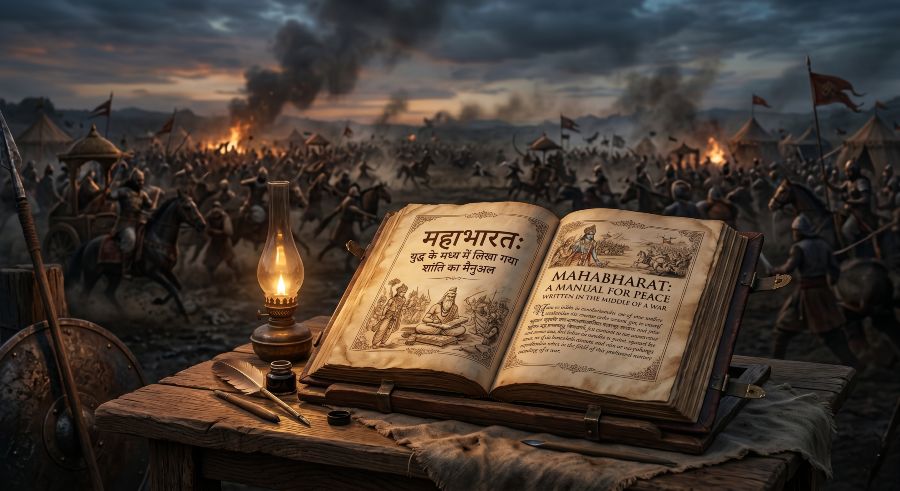
Mahabharat Book: A Manual for Peace Written in the Middle of a War
In a world constantly oscillating between conflict and calm, humanity has always searched for a guiding light—a philosophy that does not merely preach peace but explains how to find it amidst turmoil. Surprisingly, one of the most profound manuals for inner peace was not written in a serene forest or a quiet monastery, but on the battlefield of Kurukshetra. The Mahabharat is not just an epic tale of war; it is a deeply layered psychological, philosophical, and spiritual guide that reveals how peace can be cultivated even when life appears to be in complete disarray.
For those seeking a deeper understanding, the VedSoul Mahabharat Book offers a timeless interpretation that goes beyond storytelling and dives into the essence of human struggle and transcendence. Within its verses lies a roadmap—not to avoid conflict, but to navigate it with wisdom, clarity, and inner stability.
This article explores how the Mahabharat serves as a manual for peace, showing that true harmony is not the absence of war, but the mastery of the self in the midst of it.
Paradox: Peace Born in War
At first glance, it seems contradictory to associate peace with a narrative centered around one of the greatest wars in mythology. However, this paradox is precisely what makes the Mahabharat so relevant today.
The battlefield of Kurukshetra symbolizes the inner battlefield within every human being. It is where duty clashes with emotion, righteousness struggles against attachment, and clarity is clouded by doubt. The war is not merely external—it represents the eternal conflict between higher consciousness and lower impulses.
The Mahabharat teaches that peace is not a passive state achieved by avoiding challenges. Instead, it is an active process of confronting and resolving internal conflicts. The chaos of the battlefield becomes a mirror, reflecting the complexities of human life.
In modern terms, this is similar to navigating career dilemmas, relationship conflicts, or ethical decisions. The epic reminds us that peace is not found by escaping these situations but by facing them with awareness and wisdom.
The Bhagavad Gita: The Core of Inner Peace
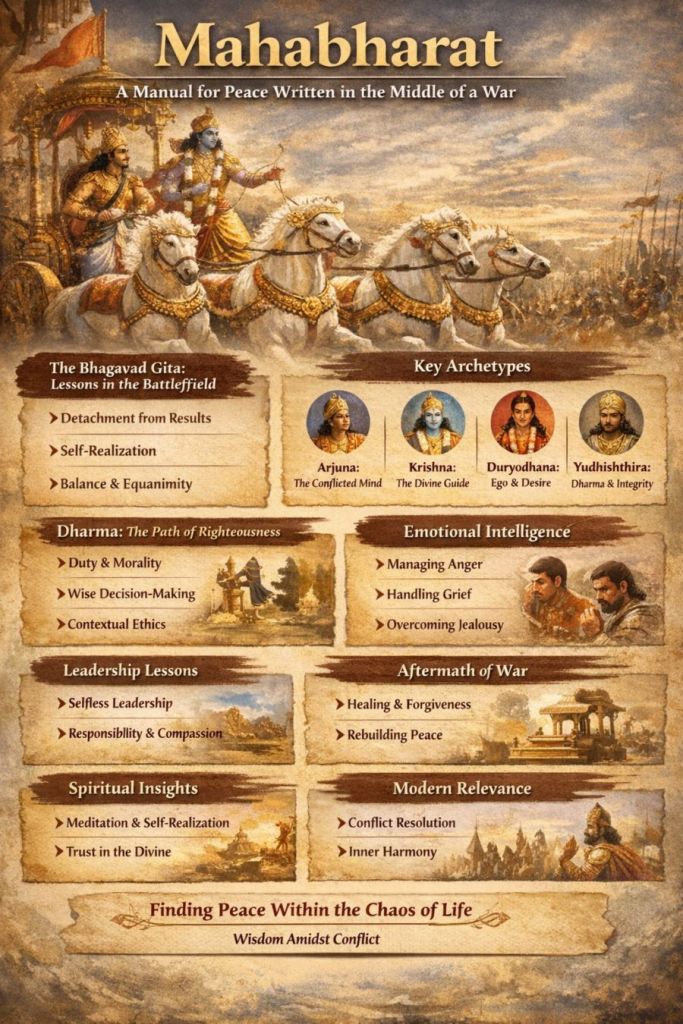
At the heart of the Mahabharat lies the Bhagavad Gita, a dialogue between Arjuna and Krishna that unfolds just before the war begins. Arjuna, overwhelmed by moral confusion and emotional turmoil, represents the human condition at its most vulnerable.
Krishna’s teachings provide a comprehensive framework for achieving inner peace:
Detachment from Results (Nishkama Karma)
Krishna emphasizes the importance of performing one’s duty without attachment to outcomes. This principle reduces anxiety and fear, which are often the biggest obstacles to peace.
When actions are driven by purpose rather than expectation, the mind becomes lighter and more focused.
Self-Realization
The Gita teaches that the true self is eternal and beyond physical existence. Understanding this reduces fear of loss, death, and failure.
This perspective shifts the focus from temporary disturbances to a deeper, unchanging reality.
Balance in All Situations
Krishna advises maintaining equanimity in success and failure, pleasure and pain. This balanced state of mind is the foundation of lasting peace.
In essence, the Bhagavad Gita transforms the battlefield into a classroom, where the greatest lessons of life are taught under the most intense circumstances.
Characters as Psychological Archetypes
One of the unique aspects of the Mahabharat is its characters, each representing different aspects of the human psyche. Understanding them helps decode the path to inner peace.
Arjuna: The Conflicted Mind
Arjuna’s hesitation reflects the inner confusion we all experience when faced with difficult decisions. His journey teaches that clarity comes through introspection and guidance.
Krishna: The Higher Self
Krishna symbolizes wisdom, consciousness, and divine guidance. He represents the voice within us that knows the truth but is often overshadowed by fear and doubt.
Duryodhana: Ego and Desire
Duryodhana embodies unchecked ambition, jealousy, and attachment. His inability to control these traits leads to destruction, highlighting the importance of self-regulation.
Yudhishthira: Dharma and Integrity
Yudhishthira represents righteousness and moral strength. His character shows that peace is rooted in living a life aligned with values.
By recognizing these archetypes within ourselves, we can better understand our internal conflicts and work towards resolving them.
The Role of Dharma in Achieving Peace
Dharma, often translated as duty or righteousness, is a central theme in the Mahabharat. However, it is not a rigid set of rules but a dynamic principle that requires context, awareness, and wisdom.
Peace arises when one aligns actions with dharma. This alignment eliminates internal conflict, as decisions are made based on clarity rather than impulse.
The Mahabharat also acknowledges that dharma is complex. Situations often arise where there is no clear right or wrong. In such cases, the epic encourages deep reflection and reliance on higher wisdom.
This nuanced understanding of dharma makes the Mahabharat incredibly relevant in today’s morally complex world.
Emotional Intelligence in the Mahabharat
Long before modern psychology introduced the concept of emotional intelligence, the Mahabharat explored it in depth.
Managing Anger
Characters like Bhima demonstrate the power of channeling anger constructively, while others show the consequences of uncontrolled rage.
Handling Grief
The epic does not shy away from loss and suffering. It portrays grief as a natural part of life, while also emphasizing resilience and acceptance.
Overcoming Jealousy
Duryodhana’s jealousy serves as a cautionary tale, illustrating how destructive emotions can lead to downfall.
By addressing these emotions, the Mahabharat provides practical insights into maintaining mental and emotional balance.
Leadership Lessons: Peace Through Responsibility
The Mahabharat is also a profound study of leadership. It shows that true leaders are those who prioritize collective well-being over personal gain.
Yudhishthira’s reign after the war is marked by justice, compassion, and fairness. His leadership style demonstrates that peace in society begins with responsible governance.
Krishna’s role as a guide rather than a ruler highlights the importance of wisdom in leadership. He empowers others to make the right decisions rather than imposing his will.
These lessons are particularly relevant in today’s world, where leadership often determines the stability and harmony of communities.
The Aftermath of War: Rebuilding Peace
One of the most powerful aspects of the Mahabharat is its focus on the aftermath of war. Unlike many stories that end with victory, the Mahabharat continues to explore the consequences of conflict.
The survivors are left to deal with loss, guilt, and the challenge of rebuilding society. This phase emphasizes that peace is not achieved through victory alone but through healing and reconciliation.
The epic teaches that true peace requires:
- Acknowledgment of suffering
- Forgiveness and compassion
- Commitment to rebuilding relationships
This perspective is invaluable in a world where conflicts often leave lasting scars.
Spiritual Insights: The Ultimate Source of Peace
At its core, the Mahabharat is a spiritual text. It teaches that lasting peace comes from understanding one’s true nature and connection to the universe.
Meditation, self-discipline, and devotion are presented as tools for achieving this state. These practices help quiet the mind and align it with higher consciousness.
The epic also emphasizes surrender—not as a sign of कमजोरी, but as an act of trust in the greater order of life.
This spiritual dimension elevates the Mahabharat from a historical narrative to a timeless guide for inner transformation.
Relevance in Modern Life
The lessons of the Mahabharat are not confined to ancient times. They are remarkably applicable to modern life.
Workplace Conflicts
The principles of detachment and duty can help navigate professional challenges with clarity and confidence.
Relationships
Understanding emotions and practicing empathy can lead to healthier and more harmonious relationships.
Personal Growth
The focus on self-awareness and discipline provides a roadmap for continuous improvement.
In a fast-paced world filled with uncertainty, the Mahabharat offers a stable foundation for finding peace.
Practical Applications: Bringing the Teachings to Life
To truly benefit from the Mahabharat, it is essential to apply its teachings in daily life.
Daily Reflection
Spend time reflecting on actions and decisions, aligning them with values and principles.
Mindful Action
Focus on the process rather than the outcome, reducing stress and increasing effectiveness.
Emotional Awareness
Recognize and manage emotions, preventing them from dictating behavior.
Seeking Guidance
Just as Arjuna turned to Krishna, seek wisdom from mentors, scriptures, or inner intuition.
These practices can transform theoretical knowledge into lived experience.
Why the Mahabharat Remains Timeless
The enduring relevance of the Mahabharat lies in its ability to address universal human experiences. It does not offer simplistic solutions but acknowledges the complexity of life.
Its teachings are not bound by time, culture, or geography. They resonate with anyone seeking clarity, purpose, and peace.
The epic’s depth ensures that each reading reveals new insights, making it a lifelong companion in the journey of self-discovery.
Conclusion: Finding Peace Within the Battlefield
The Mahabharat stands as a powerful reminder that peace is not found in the absence of conflict but in the mastery of it. It teaches that life’s challenges are not obstacles but opportunities for growth and transformation.
By understanding and applying its teachings, one can navigate the complexities of life with confidence and calmness. The battlefield of Kurukshetra becomes a metaphor for our own lives, where every struggle holds the potential for enlightenment.
In the end, the Mahabharat is not just a story—it is a guide, a mentor, and a mirror. It shows us that even in the midst of chaos, peace is always within reach, waiting to be discovered through awareness, wisdom, and self-mastery.
 VedSoul – Vedic Wisdom for the Modern Soul