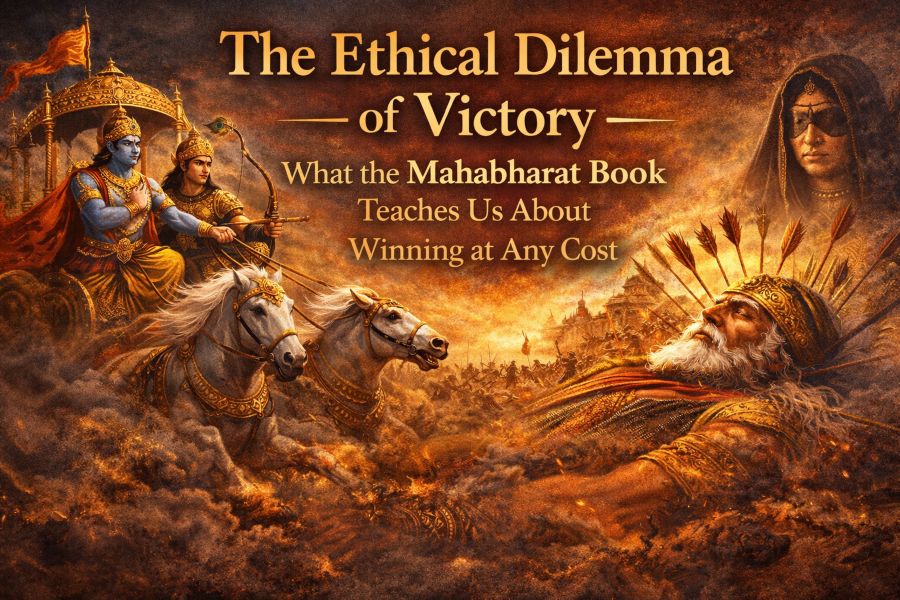
The Ethical Dilemma of Victory: What the Mahabharat Book Teaches Us About Winning at Any Cost
We grow up believing that victory is everything. Score higher, earn more, rise faster—win. But the Mahabharata unsettles this belief. It asks a question most success stories avoid: What if winning comes at a cost you cannot live with?
For readers who want to examine this question beyond surface-level morality, it helps to Buy Mahabharat Book editions that preserve the epic’s nuance and complexity. Because the Mahabharata does not celebrate victory blindly—it interrogates it. It shows us that success, when detached from ethics, can hollow a person out from within.
This is not a story about who won a war. It is a study of what it means to win.
Kurukshetra: A War That Solved Nothing
The 18-day war of Kurukshetra is often framed as the inevitable clash between good and evil. The Pandavas represent justice; the Kauravas represent ambition without restraint. The narrative seems straightforward—until it isn’t.
By the end of the war:
- The Pandavas win the kingdom
- The Kauravas are annihilated
- The battlefield is silent
And yet, nothing feels resolved.
Victory arrives, but it does not heal. It exposes. It forces every survivor to confront a truth: the price of winning is written in loss.
The Myth of Clean Victories
Modern narratives love clean victories—clear heroes, deserved outcomes, moral certainty. The Mahabharata refuses this comfort.
Consider the methods used in the war:
- Strategic deception
- Emotional manipulation
- Bending of rules
Krishna himself advises tactics that challenge conventional ethics. Bhishma is defeated through strategy that exploits his vows. Drona is disarmed through a half-truth. Karna is killed when he is vulnerable.
These are not acts of pure righteousness. They are decisions made under pressure, justified by a larger goal.
The Mahabharata asks:
👉 If the outcome is just, do the means become acceptable?
It does not answer. It leaves you in that discomfort.
Yudhishthira’s Burden: The Weight of Righteousness
Yudhishthira is known as Dharmaraja—the embodiment of righteousness. Yet, after the war, he is the most disturbed.
He wins everything he fought for, but he cannot celebrate. Instead, he is consumed by guilt:
- For the destruction caused
- For the compromises made
- For the lives lost
His crisis reveals a powerful insight:
👉 Being right does not always feel right.
Ethics is not just about correctness—it is about conscience.
Karna’s Tragedy: Loyalty vs Truth
Karna’s life is a masterclass in ethical conflict. He knows the Pandavas are his brothers. He knows Duryodhana’s cause is flawed. Yet he chooses loyalty.
Why?
Because Duryodhana gave him dignity when the world denied it.
Karna’s dilemma reflects a common human struggle:
- Do you choose truth?
- Or do you choose the person who stood by you?
There is no easy answer. Karna’s story shows that ethical decisions are rarely clean—they are entangled with emotion, history, and identity.
Krishna’s Strategy: Beyond Conventional Morality
Krishna’s role in the Mahabharata is often misunderstood. He is not a passive observer; he is an active strategist.
He does not insist on rigid morality. Instead, he focuses on restoring balance.
This leads to uncomfortable actions:
- Encouraging Arjuna to fight his own family
- Advising tactics that bend the rules
- Prioritizing outcome over process
Krishna operates on a different plane—one where the intention behind action matters more than the action itself.
But this raises a difficult question:
👉 Can higher purpose justify morally ambiguous actions?
Read Also:- Krishna Kills Kansa
The Cost of Winning: What Remains After Victory
After the war, the Mahabharata slows down. It lingers in the aftermath.
- Gandhari curses Krishna
- Yudhishthira contemplates renunciation
- The kingdom is heavy with grief
This is where the epic becomes deeply psychological.
Victory does not erase consequence. It amplifies it.
You can win the world and still lose your peace.
Dharma as a Moving Target
One of the most unsettling truths of the Mahabharata is that dharma is not fixed.
What is right in one moment may be wrong in another. What feels ethical in theory may collapse in practice.
This fluidity makes decision-making difficult—but also honest.
The Mahabharata teaches:
👉 Dharma is not a rulebook. It is awareness in action.
It requires:
- Context
- Intention
- Reflection
Without these, even good actions can lead to harm.
Winning at Any Cost: A Modern Obsession
The Mahabharata feels ancient, but its lessons are strikingly modern.
Today, we see “winning at any cost” everywhere:
- In corporate competition
- In politics
- In personal relationships
People chase outcomes—titles, wealth, validation—often ignoring the means.
But the pattern remains the same:
- Short-term success
- Long-term unrest
The Mahabharata warns us:
👉 If the path is compromised, the destination will not satisfy.
The Inner Conflict: Success vs Integrity
At its core, the Mahabharata is about internal conflict.
Every major character faces a choice:
- Arjuna: Fight or withdraw
- Karna: Loyalty or truth
- Yudhishthira: Rule or renounce
These are not external decisions—they are internal negotiations.
And this is where the epic becomes personal.
We all face moments where:
- Success demands compromise
- Integrity demands sacrifice
The question is not what is easier. The question is:
👉 What can you live with?
The Psychology of Ethical Decision-Making
The Mahabharata understands something modern psychology confirms:
Humans do not make decisions purely based on logic. We are influenced by:
- Emotion
- Bias
- Fear
- Attachment
This is why ethical dilemmas are so complex.
The epic does not simplify this complexity. It embraces it.
It shows that clarity comes not from eliminating conflict, but from engaging with it consciously.
Why the Mahabharata Does Not Give Easy Answers
Unlike many texts, the Mahabharata does not conclude with moral clarity.
There is no final statement that says:
👉 “This is the right way to live.”
Instead, it leaves you with questions.
Because real life does not offer clean answers. It offers situations.
And in each situation, you must decide.
Applying the Lessons Today
The value of the Mahabharata lies in its applicability.
In Career
- Choose growth without compromising values
- Recognize when ambition becomes destructive
In Relationships
- Balance loyalty with honesty
- Avoid silence in the face of injustice
In Personal Life
- Reflect before acting
- Understand your motivations
The goal is not perfection. It is awareness.
The Real Definition of Victory
By the end of the Mahabharata, one realization stands out:
👉 Victory is not what you gain. It is what you can live with.
This redefines success.
It shifts focus from:
- Outcome → to process
- Achievement → to alignment
- Winning → to peace
Conclusion: The Question That Stays With You
The Mahabharata does not tell you how to win. It tells you how to think about winning.
It shows that:
- Success without ethics is unstable
- Power without reflection is dangerous
- Victory without peace is empty
And perhaps its most important lesson is this:
👉 Before you ask “How do I win?”, ask “What will it cost me?”
Because in the end, the greatest victory is not over others.
It is over the part of yourself that is willing to win at any cost.
 VedSoul – Vedic Wisdom for the Modern Soul