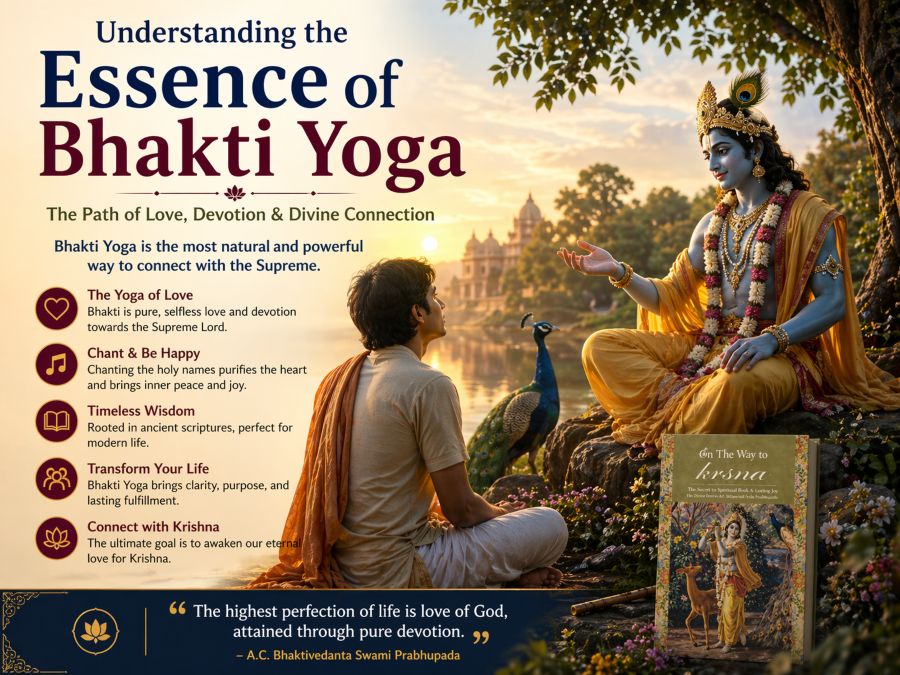
Understanding the Essence of Bhakti Yoga
In an age defined by speed, distraction, and constant striving, people are increasingly asking deeper questions: What is the purpose of life? Why does happiness feel temporary? Is there a path that leads to lasting fulfillment? Bhakti Yoga offers a profound answer—one that is both ancient and urgently relevant today. It is not merely a philosophy or ritual system, but a living, breathing path of connection between the individual soul and the Supreme.
A powerful gateway into this understanding can be found in the On The Way to Krishna Book, which clearly explains how devotion becomes the foundation of true joy and self-realization. Bhakti Yoga is often described as the “yoga of love,” but this simple phrase carries immense depth. It is a systematic process of transforming consciousness from self-centeredness to God-centeredness.
What is Bhakti Yoga?
Bhakti Yoga comes from two Sanskrit roots: bhakti (devotion or loving service) and yoga (union or connection). Together, they describe a process of re-establishing our lost relationship with the Divine.
Unlike other paths of yoga that emphasize physical postures or intellectual inquiry, Bhakti Yoga focuses on relationship. It recognizes that the soul’s natural function is to love and serve. When that love is directed toward temporary objects, it leads to frustration. But when directed toward the Supreme, it results in lasting satisfaction.
Bhakti Yoga is not restricted by age, education, or background. It is universal because love itself is universal.
The Spiritual Identity: Beyond the Body
At the core of Bhakti Yoga lies a foundational realization: we are not the body, but the eternal soul.
Modern identity is often built on external factors—appearance, profession, social status. However, these are temporary. Bhakti Yoga teaches that the true self (atma) is:
- Eternal
- Full of knowledge
- Naturally blissful
When we misidentify with the body, we experience fear, anxiety, and dissatisfaction. Bhakti Yoga begins by correcting this misunderstanding.
This shift is not just philosophical—it changes how we see ourselves and the world. Life becomes less about competition and more about connection.
The Supreme Object of Love
Bhakti Yoga centers on understanding the Supreme as a personal, loving being—Krishna.
Krishna is described as:
- The source of all existence
- The reservoir of pleasure
- The ultimate object of love
Every relationship we experience in the material world reflects a deeper, original relationship with Krishna. Our longing for love, companionship, and meaning is actually a reflection of our spiritual nature.
When that love is redirected toward Krishna, it becomes complete.
The Difference Between Material Love and Spiritual Love
Material love is often conditional and temporary. It depends on circumstances and expectations. When those expectations are not met, disappointment arises.
Spiritual love, as taught in Bhakti Yoga, is:
- Unconditional
- Eternal
- Ever-increasing
In material relationships, we often seek to receive. In Bhakti, the focus shifts to giving—serving with love.
This change transforms relationships, not by rejecting them, but by purifying them.
The Nine Processes of Bhakti
Bhakti Yoga is expressed through nine primary practices, each offering a way to connect with the Divine:
- Hearing about Krishna
- Chanting His names
- Remembering Him
- Serving His feet
- Worship
- Prayer
- Servitude
- Friendship
- Complete surrender
Among these, chanting is considered the most accessible and powerful in the current age.
The Power of the Holy Name
One of the central practices of Bhakti Yoga is chanting the holy names of God, especially the Hare Krishna maha-mantra:
Hare Krishna Hare Krishna Krishna Krishna Hare Hare
Hare Rama Hare Rama Rama Rama Hare Hare
This chanting is not a ritual—it is a direct spiritual experience.
The sound vibration:
- Cleanses the mind
- Awakens spiritual awareness
- Connects the soul with Krishna
Unlike material activities, its effect is cumulative and permanent.
Read Also:- Krishna Kills Kansa
Bhakti Yoga in Daily Life
One of the most beautiful aspects of Bhakti Yoga is its practicality. It does not require withdrawal from the world. Instead, it transforms daily activities into spiritual practices.
For example:
- Eating becomes sacred when food is offered to Krishna
- Work becomes meaningful when done as service
- Speaking becomes uplifting when centered on truth
This integration makes Bhakti Yoga sustainable and deeply impactful.
The Role of Simplicity and Discipline
Bhakti Yoga encourages a lifestyle of simple living and high thinking.
This includes:
- Regulating habits
- Avoiding harmful behaviors
- Focusing on spiritual growth
Discipline is not about restriction—it is about alignment. It helps redirect energy from temporary distractions to meaningful pursuits.
Over time, this creates clarity and inner stability.
The Importance of Association
Association plays a crucial role in shaping consciousness.
Bhakti Yoga emphasizes the value of spending time with spiritually minded individuals. Such association:
- Strengthens faith
- Provides guidance
- Encourages growth
Communities like the ISKCON offer environments where Bhakti can be practiced collectively.
This shared journey makes the path joyful and supportive.
Overcoming Obstacles on the Path
Like any meaningful journey, Bhakti Yoga comes with challenges:
- Doubt
- Distraction
- Lack of consistency
However, these are natural and temporary.
Bhakti teaches that progress is not about perfection, but persistence. Even small efforts have lasting impact.
With time, obstacles become opportunities for growth.
The Science Behind Bhakti Yoga
Bhakti Yoga is often misunderstood as emotional or sentimental. In reality, it is deeply scientific.
It provides:
- A clear understanding of the self
- A structured process for transformation
- Observable results in consciousness
Practitioners often report:
- Reduced stress
- Increased clarity
- Greater emotional resilience
These outcomes are not theoretical—they are experiential.
Freedom from Anxiety and Fear
Much of human suffering comes from attachment to temporary things.
Bhakti Yoga addresses this by shifting focus from the temporary to the eternal.
When one understands:
- The soul is eternal
- Krishna is the ultimate protector
Fear naturally diminishes.
This creates a sense of security that is not dependent on external circumstances.
The Goal of Bhakti Yoga
The ultimate goal of Bhakti Yoga is to develop pure love for Krishna.
This state is characterized by:
- Complete satisfaction
- Freedom from material desires
- Constant connection with the Divine
It is not an abstract ideal—it is a realizable condition.
In this state, life becomes joyful, purposeful, and deeply fulfilling.
Bhakti Yoga vs Other Paths
There are many spiritual paths—karma (action), jnana (knowledge), and others.
Bhakti Yoga is unique because:
- It is both the means and the goal
- It is accessible to everyone
- It emphasizes relationship over abstraction
While other paths may lead to partial realization, Bhakti leads to complete understanding.
Why Bhakti Yoga is Relevant Today
Modern life is filled with complexity, yet Bhakti offers simplicity.
In a world of:
- Information overload
- Emotional instability
- Constant pressure
Bhakti provides:
- Clarity
- Stability
- Inner peace
Its relevance is not limited by time or culture.
A Journey of Transformation
Bhakti Yoga is not about instant results. It is a gradual process of transformation.
With consistent practice:
- Desires change
- Priorities shift
- Awareness deepens
What once seemed important begins to lose significance, while spiritual connection becomes central.
This transformation is natural and sustainable.
Practical Steps to Begin Bhakti Yoga
Starting Bhakti Yoga does not require drastic change. Begin with simple steps:
- Chant daily
- Read spiritual literature
- Offer food before eating
- Seek spiritual association
- Practice gratitude
Consistency is more important than intensity.
Conclusion: The Essence of Bhakti Yoga
The essence of Bhakti Yoga lies in love—pure, unconditional, and eternal.
It teaches that
- We are spiritual beings
- Our purpose is to love and serve
- True happiness lies in reconnecting with Krishna
In a world searching for meaning, Bhakti Yoga offers not just answers but experience.
It is a path that begins with curiosity and leads to transformation. A path where knowledge becomes realization, and practice becomes joy.
For those willing to explore, Bhakti Yoga is not just a philosophy—it is a way of life that leads to lasting peace, fulfillment, and divine connection.
 VedSoul – Vedic Wisdom for the Modern Soul