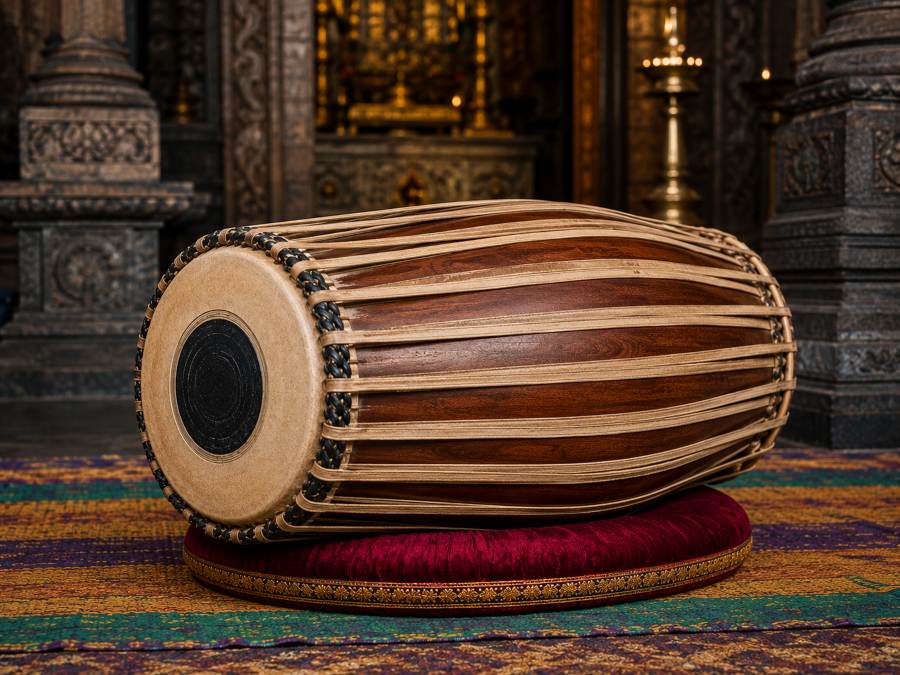
History of the Mridangam: The Ancient Roots of Carnatic Music’s King of Percussion
Before microphones existed, before concert halls were built, and before modern music theory gave rhythm mathematical names, a barrel-shaped drum echoed through Indian temples, royal courts, devotional gatherings, and sacred performances. Its sound carried authority. Not loud authority. Rhythmic authority.
That instrument was the Mridangam.
Today, many musicians proudly call it the “King of Percussion” in Carnatic music. Yet its story stretches far beyond concert stages. The history of the Mridangam is deeply tied to spirituality, ancient Indian philosophy, temple traditions, dance culture, and the emotional heartbeat of South Indian classical music.
Even now, traditional music lovers searching through the ISKCON Mayapur Online Store often see how strongly devotional culture remains connected with sacred percussion traditions. The Mridangam is not merely an instrument preserved for nostalgia. It continues to breathe inside living spiritual and musical communities.
And the deeper you explore its past, the more fascinating the story becomes.
Long Before Carnatic Music Had a Formal Structure
One mistake people often make is assuming the Mridangam was created specifically for modern Carnatic concerts.
It was not.
The instrument existed long before Carnatic music became systematized in the form recognized today. Ancient India already possessed highly sophisticated rhythmic traditions tied to:
- Temple worship
- Dance dramas
- Sacred chanting
- Folk ceremonies
- Storytelling performances
Rhythm played an essential role in preserving collective cultural memory. In largely oral civilizations, percussion helped structure performances, synchronize movement, and intensify emotional experience.
The Mridangam emerged naturally from this environment.
The Meaning Hidden Inside the Name
The word “Mridangam” itself tells part of the story.
It comes from Sanskrit:
- Mrid — clay or earth
- Angam — body
This linguistic origin strongly suggests early forms of the instrument were originally made using clay bodies rather than carved wood.
That detail matters because ancient Indian musical instruments were deeply connected with natural materials:
- Earth
- Wood
- Leather
- Metal
- Bamboo
Sound was viewed as an extension of nature itself, not something artificially separated from life.
Even today, many traditional musicians believe clay-based Mridangams carry a softer, earthier tonal character linked to the instrument’s earliest identity.
Ancient India Already Understood Rhythm at an Advanced Level
People often underestimate how mathematically advanced ancient Indian rhythm systems were.
Centuries before many modern rhythmic theories developed elsewhere, Indian musicians had already created astonishingly sophisticated concepts involving:
- Cyclic timing structures
- Fractional beat divisions
- Improvisational resolution patterns
- Complex rhythmic layering
- Vocal percussion systems
The Mridangam evolved inside this intellectual environment.
This is why the instrument never functioned as a simple background drum. It became a rhythmic language.
Even today, experienced performers speak percussion syllables vocally through systems like:
- Tha
- Thom
- Nam
- Dhi
- Ki Ta Thom
This oral rhythmic training tradition remains one of the most intellectually rich percussion systems in the world.
Temple Culture Gave the Mridangam Spiritual Power
The history of the Mridangam cannot be separated from temples.
That connection shaped the instrument permanently.
In ancient South Indian temple culture, music was not treated as entertainment alone. It formed part of worship itself. Sound created atmosphere for:
- Ritual ceremonies
- Devotional singing
- Sacred dance
- Festival processions
- Spiritual storytelling
The Mridangam became essential because rhythm controlled collective emotional energy.
Temple architecture amplified percussion beautifully. Stone halls reflected low frequencies with extraordinary warmth. Combined with chanting, bells, lamps, incense, and devotional movement, rhythmic sound became immersive.
The instrument began carrying spiritual associations that remain powerful even today.
Bharatanatyam and the Rise of Rhythmic Sophistication
The development of Bharatanatyam dance significantly elevated the artistic importance of the Mridangam.
Dance required:
- Precision timing
- Emotional pacing
- Rhythmic coordination
- Narrative emphasis
Percussionists could no longer simply maintain tempo. They needed to communicate dynamically with dancers in real time.
This transformed the role of the mridangist into something highly specialized.
Great percussionists learned to:
- Anticipate movement
- Shape dramatic tension
- Support expressive storytelling
- Guide transitions emotionally
The interaction between dancer and percussionist became almost conversational.
That relationship pushed rhythmic artistry to remarkable levels.
The Royal Courts That Helped Shape the Instrument
While temples nurtured spiritual depth, royal courts helped refine artistic sophistication.
South Indian kings and regional rulers often supported musicians generously. Court patronage created environments where performers could:
- Experiment rhythmically
- Develop advanced techniques
- Train disciples
- Refine tonal craftsmanship
- Expand compositional structures
This support mattered enormously.
Without patronage systems, highly advanced classical traditions struggle to survive because mastery requires years of dedicated practice.
Many legendary rhythmic innovations emerged during periods when musicians received sustained cultural support from courts and wealthy institutions.
The Shift From Clay to Wood Changed Everything
At some point, wooden shells gradually became dominant over clay constructions.
Jackfruit wood eventually emerged as the preferred material for many professional instruments.
Why?
Because performance needs evolved.
Wood offered:
- Better durability
- Stronger projection
- Greater tuning stability
- Improved resistance to climate changes
- Longer lifespan
As Carnatic music moved into larger concert spaces, musicians needed instruments capable of delivering tonal clarity across bigger audiences.
Clay still possessed emotional warmth and traditional appeal, but wood adapted more effectively to modern performance demands.
This transition changed the tonal identity of the instrument permanently.
Why the Mridangam Became the Heart of Carnatic Music
Carnatic music depends heavily on rhythmic sophistication.
The Mridangam became central because it could support both:
- Structure
- Improvisation
That balance is rare.
A great mridangist does not merely follow compositions mechanically. They actively participate in shaping the emotional and mathematical journey of the performance.
This includes:
- Supporting vocal phrasing
- Enhancing tension and release
- Guiding tempo stability
- Responding to improvisation instantly
- Creating rhythmic excitement
Eventually, audiences began treating master percussionists with the same respect traditionally given to vocalists.
That elevated status helped cement the Mridangam’s reputation as Carnatic music’s premier percussion instrument.
Tani Avartanam Changed Audience Expectations
One major reason the Mridangam gained legendary status was the rise of tani avartanam — the percussion solo section in Carnatic concerts.
This section allows percussionists to display:
- Rhythmic creativity
- Mathematical precision
- Technical mastery
- Emotional intelligence
- Improvisational depth
Listeners often become intensely focused during these solos because the rhythmic structures build suspense psychologically.
The audience may not consciously calculate every pattern, but they feel the tension and release physically.
When a performer resolves a highly complex rhythmic sequence perfectly back into the main cycle, the effect can feel electrifying.
The Great Masters Who Redefined Percussion
The instrument’s history includes extraordinary artists whose innovations transformed Carnatic rhythm forever.
Certain masters became legendary for:
- Tonal refinement
- Speed and clarity
- Rhythmic mathematics
- Emotional sensitivity
- Accompaniment artistry
They elevated expectations for what percussion could accomplish.
Some focused on tonal beauty.
Others pushed rhythmic complexity.
Some developed highly influential teaching traditions.
Many modern performers still study their recordings obsessively.
Their influence continues shaping how the instrument is taught and performed today.
The Spiritual Side Never Disappeared
Even as concert culture modernized, the spiritual roots of the Mridangam never vanished.
That is one reason the instrument remains emotionally powerful.
Unlike some classical traditions that became disconnected from sacred practice, the Mridangam continued living inside:
- Temple kirtans
- Bhajan gatherings
- Devotional festivals
- Spiritual communities
- Pilgrimage traditions
This dual identity makes the instrument unique.
It can exist comfortably in:
- Highly intellectual classical concerts
- Deeply emotional devotional chanting
- Traditional dance performances
- Intimate spiritual gatherings
Few percussion instruments navigate all these worlds so naturally.
Why ISKCON and Bhakti Traditions Embraced Percussion
Bhakti traditions emphasize collective chanting and emotional participation.
Rhythm plays a vital role in sustaining that energy.
The Mridangam became deeply associated with devotional culture because it supports:
- Congregational singing
- Repetitive mantra chanting
- Group synchronization
- Emotional immersion
- Spiritual enthusiasm
In many Vaishnava communities, percussion is not viewed as decoration. It acts as devotional support helping people focus more deeply during kirtan.
That living devotional use helped preserve the instrument across generations.
The Science Behind Its Remarkable Sound
The Mridangam’s tonal complexity comes from highly refined craftsmanship.
The instrument uses two distinct drumheads:
- One side creates sharper tonal articulation
- The other produces deeper bass resonance
The famous black tuning patch on the right side dramatically shapes harmonic behavior. This allows the instrument to generate unusually rich tonal textures compared to many percussion systems.
A skilled player can produce:
- Sharp attacks
- Deep bass
- Muted textures
- Ringing tones
- Rapid articulations
All from a single instrument.
That versatility helped the Mridangam maintain dominance inside Carnatic rhythm traditions.
Why Learning the Mridangam Takes Years
People often underestimate how demanding the instrument truly is.
Students must develop:
- Finger strength
- Timing precision
- Rhythmic memory
- Hand independence
- Listening awareness
- Improvisational thinking
And this happens slowly.
Very slowly.
Unlike instruments where beginners can quickly imitate basic melodies, the Mridangam exposes weak timing immediately. Progress requires repetition, patience, and mental discipline.
That long training process creates deep respect for master performers.
The Instrument Entered Global Music Conversations
For centuries, the Mridangam remained mostly associated with South Indian traditions.
Then global musicians began noticing something remarkable.
The rhythmic systems surrounding the instrument were astonishingly advanced.
Jazz musicians, percussion researchers, and world music artists started studying:
- Konnakol
- Carnatic rhythm cycles
- Mathematical improvisation
- Polyrhythmic structures
Many became fascinated by how intellectually sophisticated the tradition already was long before modern rhythm theory discussions became fashionable internationally.
This helped introduce the instrument to wider audiences.
The Digital Era Changed Preservation Forever
Historically, rhythmic knowledge passed primarily through:
- Oral teaching
- Guru-disciple traditions
- Live performance exposure
Digital recording changed everything.
Rare performances once accessible only to select students suddenly became available globally. Young musicians across continents could now study legendary artists through recordings and online lessons.
This accessibility helped preserve traditions that might otherwise have weakened over time.
At the same time, live performance still matters deeply because the physical resonance of the instrument cannot be fully captured digitally.
Why the Mridangam Still Feels Timeless
Many ancient instruments survive only as museum artifacts.
The Mridangam remains alive because it still serves real emotional and spiritual functions.
It continues helping people:
- Celebrate
- Worship
- Dance
- Meditate
- Perform
- Connect
That living relevance matters enormously.
The instrument adapts across generations without losing its core identity.
More Than a Drum
Calling the Mridangam merely a percussion instrument feels incomplete.
Its history reflects:
- Ancient philosophy
- Sacred sound traditions
- Temple culture
- Rhythmic mathematics
- Emotional storytelling
- Spiritual discipline
Few musical instruments carry such layered identity.
That is why audiences still react so strongly when hearing it performed well. The sound carries centuries of memory inside it.
Every rhythmic phrase echoes traces of:
- Temple halls
- Royal courts
- Dance traditions
- Devotional gatherings
- Guru-disciple lineages
- Generations of artistic discipline
And that long journey is exactly why the Mridangam still reigns as Carnatic music’s true king of percussion.
 VedSoul – Vedic Wisdom for the Modern Soul